maturity model
Mature or just routine?
A maturity model makes development stages visible – related to technologies, organizations, processes, or as in our case, to the quality of time and expectations for leadership and management styles. But be careful: Long-term experience can just as well be an expression of sovereignty as it can be of habit.
Only the perspective through the lens of the age shows whether leadership is truly mature – or merely being professionally managed.
Maturity does not mean "having it under control", but being aware, of where one stands and what is needed next. This is precisely where maturity models come into play: They provide orientation – which skills matter today and which steps will be crucial tomorrow.

Model
Digitalization influences leadership, management, and leadership
Our first maturity model reflects central aspects typical of the respective era. The clusters "Technology" and "Organization" primarily describe the framework conditions under which leadership takes place. The areas "Management" (operational) and "Leadership" (strategic) clarify which tasks and expectations leaders have to fulfill in the respective time period.
According to IFIDZ, clear delineations are not always possible – therefore, we consciously show overlaps because true leadership always moves between structure and attitude.
We have illustrated the IFIDZ understanding of the different maturity levels of digitalization in the graphic below. It visualizes the topic of leadership from the analog to the post-digital age. In the graphic, the timeline was deliberately not related continuously because the transition between the different maturity levels is fluid. Instead, we have chosen possible starting points as well as the analog age as a possible endpoint events that have fundamentally reversed or will still reverse the relationship between people and digital technologies.

Tools
Our tools for determining personal leadership maturity levels
Our Potential Check - 'LEADT - Leadership for Digital Transformation'
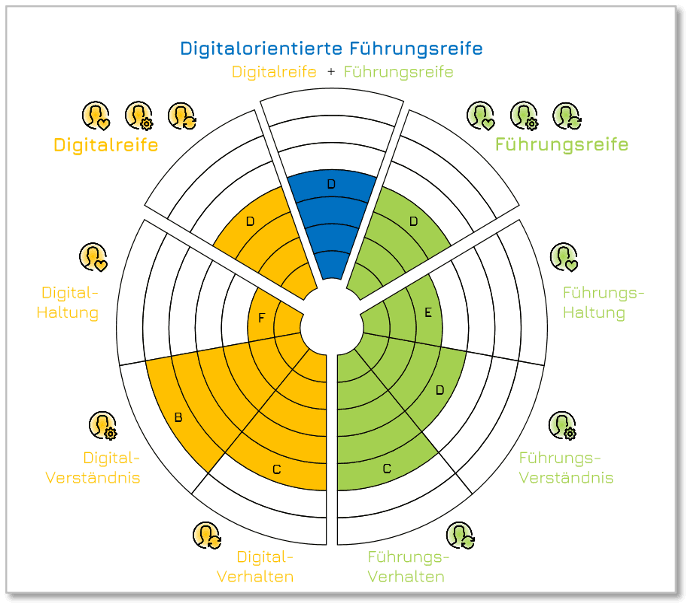
The LEADT assesses how well executives are positioned to meet the demands of digital transformation – regarding two dimensions: their leadership quality and their digital maturity.
Its development is based on current scientific findings and practical criteria. It clearly shows how these two areas are already effective through the attitude, understanding, and behavior of the executive.
At the same time, it becomes clear where there is potential for development to lead confidently and competently in complex digital environments. The LEADT is divided into 7 maturity levels and provides a well-founded assessment of digital-oriented leadership maturity – based on an overall profile and six sub-results.
Alpha Intelligence Navigator
The Alpha Intelligence Navigator determines the maturity level of the five central intelligences of future leadership – referring to one's own personality, the intelligence for building relationships, digital sovereignty, resilience in crises, and the intelligence to work harmoniously with people and machines.
It provides a precise profile of each facet and shows which neuropsychological and behavioral skills are already well developed and where a leader can start to act more effectively in dynamic times.