Trend barometer
Results November 2025
How "crisis-resistant" are leaders and their teams?
An online survey by IFIDZ shows: Many leaders know what constitutes “good leadership” in times of crisis or transformation, but they do not always succeed in implementing it in daily work life.
In recent years, the leaders of most companies and their teams had to respond to numerous crises and unforeseen events that often threatened the existence of their organization or at least disrupted their planning. This will - with almost certainty - continue to be the case in the future.
168 leaders surveyed about their “crisis resilience”
Therefore, IFIDZ investigated in its latest Leadership Trend Barometer how well leaders in companies and their teams are already prepared for crises and upheavals in their organization and its environment. The online survey under the title “How crisis-resistant are you and your team?” included 168 mostly middle and upper-level leaders.
The survey revealed: Most leaders already have a pronounced awareness of the demands on leadership in a (working) world marked by rapid and often unpredictable change.
Leaders know what makes their teams “crisis-resistant”
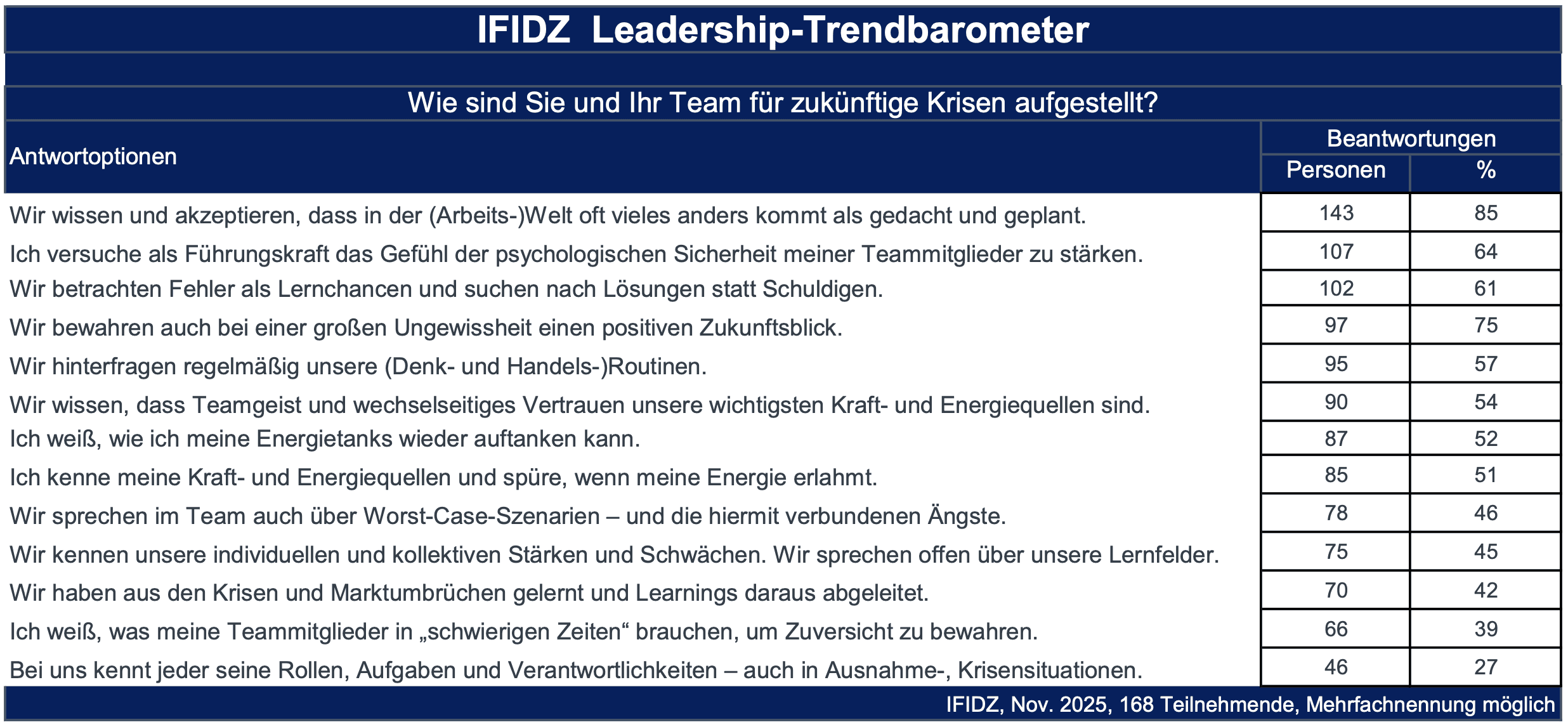
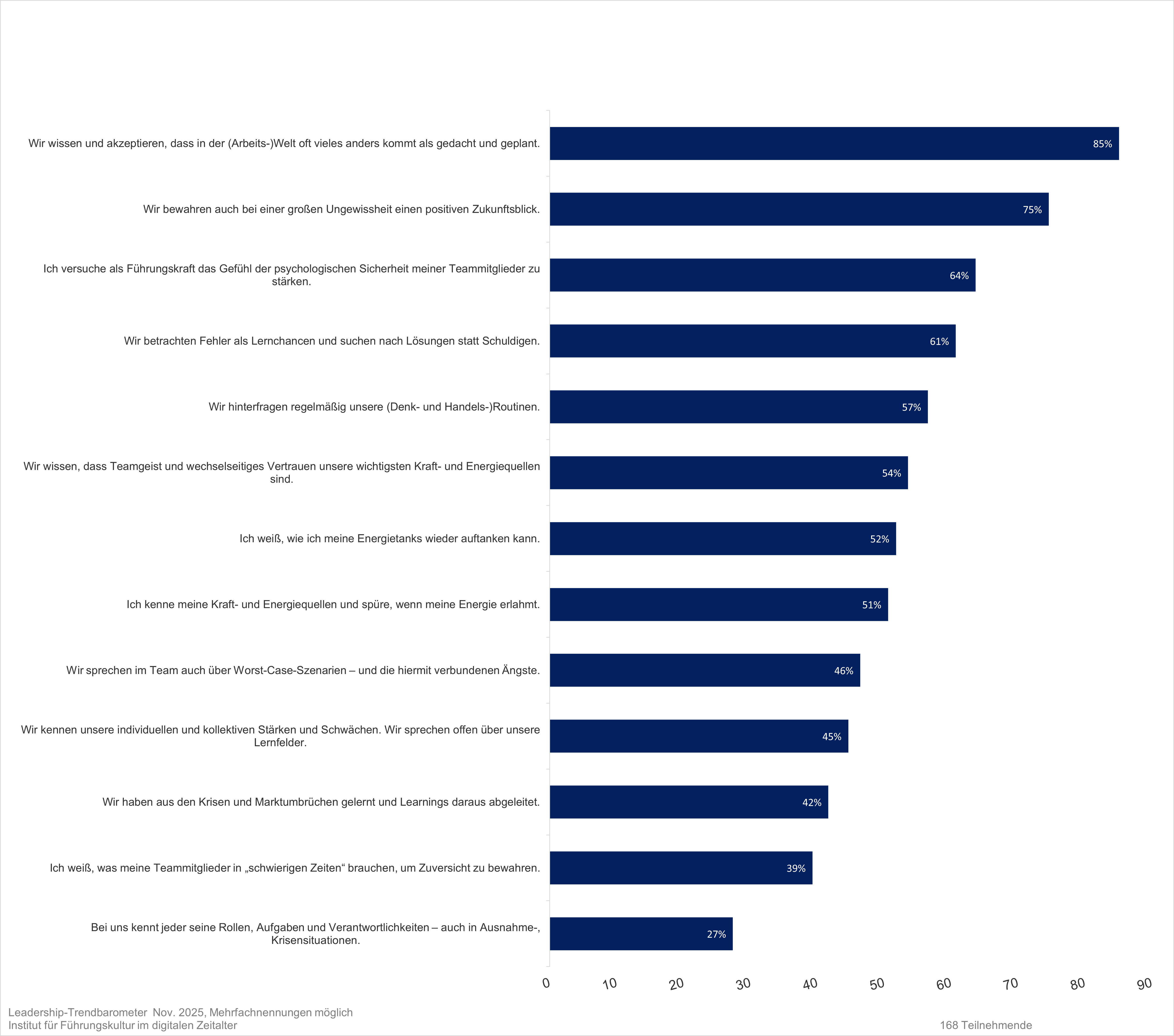
For example, about 85 percent of respondents were convinced that the working world today is no longer as predictable as it used to be. Additionally, 75 percent emphasized that they would maintain a positive outlook for the future even amidst significant uncertainty.
It is also encouraging that
• about two-thirds of leaders (64 percent) see it as one of their central tasks to strengthen the feeling of psychological safety of their team members, and
• almost as many (61 percent) perceive mistakes and omissions in the past as learning opportunities.
Moreover, 54 percent of them are aware that team spirit and mutual trust are the most important sources of strength and energy when coping with crises and solving problems together.
In everyday leadership, leaders often reach their limits
Nevertheless, it seems that in daily business practice there is a gap between the knowledge of what is necessary and the lived practice. The following factors indicate this: Less than half of the respondents agree with the statement
• “We also talk in the team about worst-case scenarios and the fears associated with them” (46 percent) and
• “We know our individual and collective strengths and weaknesses and openly discuss our learning fields” (45 percent).
It is therefore not surprising that only 39 percent of leaders say they know what their team members need in “difficult times to maintain their confidence.” And only 27 percent agree with the statement, “In our team, everyone knows their roles, tasks, and responsibilities even in exceptional and crisis situations.”
Leaders need and desire more support
This indicates that many leaders need more support in fulfilling their roles in their organization – whether in the form of individual coaching, tailored training, or forums that facilitate cross-departmental experience exchange with colleagues. This was also confirmed by the in-depth personal interviews that IFIDZ conducted with about 15 percent of the survey participants. They expressed almost unanimously that they sometimes felt overwhelmed in recent years and reached their limits.
Task: Avoid burnout among leaders
Accordingly, the risk is high for many leaders that they will burn out due to the constant pressure over time. This is also in light of the fact that in the online survey only slightly less than half of the leaders emphasized, “I know my sources of strength and energy and feel it when my energy wanes” (51 percent) and “I know how to refill my energy tanks” (52 percent).